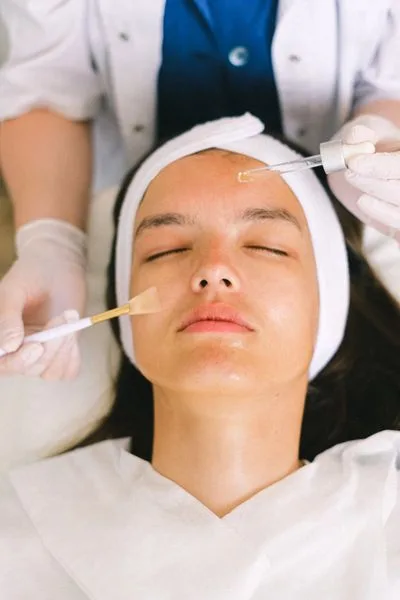
Short answer: Scarlet X suits people whose main complaint is the texture of their skin and who do not yet have sagging severe enough to require surgery. Visible pores, depressed scars left by acne, an uneven skin surface, fine lines and early laxity are the concerns most often treated. If, on the other hand, your main complaint is advanced sagging, genuine excess skin or volume loss, Scarlet X is not the right procedure for you.
Scarlet X delivers radiofrequency energy to a chosen depth in the skin through gold-plated microneedles. The needles carry the energy past the surface into the targeted layer, so the epidermis is relatively spared while a controlled repair and collagen response is initiated underneath. Depth and intensity are adjusted to the area and the complaint, which is why the same device can be used for anything from pore treatment to fine lines on the neck. Our Scarlet X technology page describes the device in more detail.
Radiofrequency differs from lasers in one important respect: it does not rely on a colour target such as melanin. That makes it relatively more comfortable to use in darker skin types, where lasers require particular caution regarding pigment change. This does not mean there is no risk at all; skin type, previous procedures and sun exposure are assessed individually in every patient.
This is not a single-session treatment. Several spaced sessions are usually planned, and the result becomes clearer over months as the collagen response matures. Redness, mild swelling and a temporary textured appearance from the needle marks are expected afterwards and settle within days. Using sun protection and avoiding irritant products during healing has a direct effect on the outcome.
Who is it not for? Radiofrequency is not used in people with a pacemaker, an implantable cardioverter defibrillator or a similar implanted electronic device. It is not used during pregnancy or breastfeeding. If there is active infection, an active cold sore or an inflammatory skin condition in the treatment area, the procedure is postponed. A tendency to keloid or hypertrophic scarring, recent isotretinoin use, uncontrolled diabetes, immunosuppressive therapy and metal implants in the treatment area all require careful assessment. None of this replaces an examination; suitability is determined individually.
Limits: Scarlet X does not replace surgical lifting. Where there is genuine excess skin, the appropriate option may be surgery such as a facelift. It does not restore lost volume — filler and biostimulator treatments are a separate subject. In deep, ice-pick type acne scarring it may be insufficient on its own and can be planned alongside complementary approaches such as chemical peeling. It is not the first-line treatment for pigment problems such as melasma.
Results vary from person to person with skin type, age, the depth of the problem and lifestyle; no specific outcome or number of sessions can be guaranteed. Suitability can only be determined by a medical consultation.